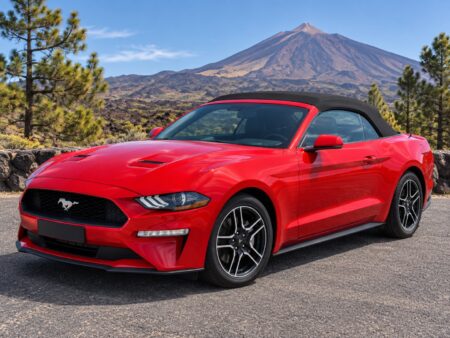
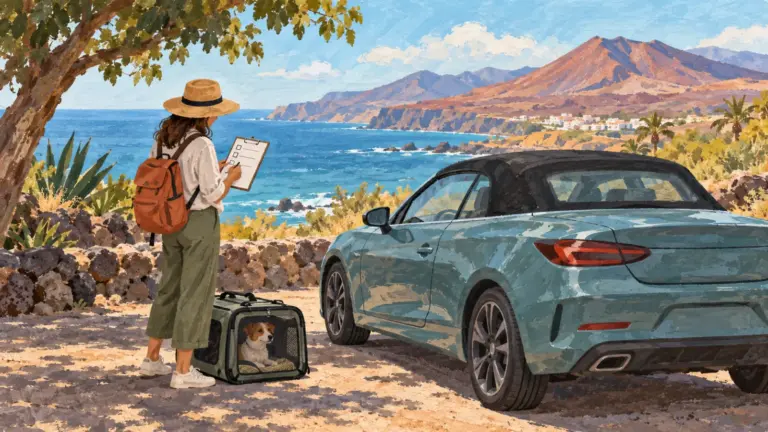
There is a moment on the way up to Teide when the road enters cloud, holds you in grey for a few minutes, and then releases you into hard sunlight with a white plain stretching to the horizon below. You are above the weather. With the roof down it is one of the most striking things you can do in a car in Europe, and it is available most mornings of the year to anyone willing to leave early enough.
The cloud sea (mar de nubes) explained
The mar de nubes is a product of the trade winds. Moist Atlantic air pushes against the north of the island, rises, cools and condenses into a dense layer of cloud that sits against the northern slopes. Above that layer the air is dry and remarkably clear. The result is a sharp ceiling of white that you can drive through in a couple of minutes, leaving the coast in cloud while you continue upward in full sun.
This is why a grey morning in Puerto de la Cruz is not a reason to cancel the drive. In fact it is often the opposite: the thicker the cloud below, the more complete the sea of white looks from above. Visitors who judge the day from a hotel balcony in the north routinely miss the best conditions on the mountain. The south of the island is generally clearer at ground level, so the effect there is less dramatic but the ascent is just as rewarding.
The layer is not permanent and its height varies. Some days it sits low and you break through early; other days it climbs and you drive in cloud for longer. Occasionally there is no inversion at all and the whole island is clear. All of these produce a good drive, but the classic view of the cloud sea belongs to the mornings when the north is overcast.
Best routes up: TF-21 vs TF-24
The TF-21 is the direct approach and the one most people take. From the north it climbs out of the Orotava valley through Aguamansa, rising steadily through pine forest before opening into the high volcanic landscape. From the south it comes up through Vilaflor, the highest village on the island, on a road of long sweeping curves. Both halves of the TF-21 are excellent; the southern side is usually sunnier and slightly less demanding, the northern side more atmospheric because of the forest and the cloud.
The TF-24 is the connoisseur’s choice. Known as the Esperanza road, it runs along the spine of the island from near La Laguna, threading for kilometre after kilometre through tall Canary pine. It takes longer, the surface is narrower, and there are fewer places to stop, but it delivers something the TF-21 cannot: a slow, quiet climb through forest with the cloud layer drifting between the trunks. With the roof down the smell of warm pine is worth the extra time on its own.
A good compromise is to go up one way and come down the other. Ascend the TF-24 for the forest, cross the high plateau, and descend the TF-21 towards Vilaflor and the south, or the reverse if you are staying in the north. That gives you two entirely different drives in a single day without repeating a single kilometre.
When to leave and what to pack
Leave early. The light is better, the roads are emptier, and the cloud layer is usually at its most defined in the morning. An early start also means you reach the high plateau before the coaches and before the mid-afternoon haze that can soften the views. If you plan to use the cable car, arriving early matters even more, because queues build steadily through the day and high winds can suspend operations at short notice.
Pack for a different climate than the one you left. Teide is the highest point in Spain at 3,715 metres, and the road tops out well over 2,000. The temperature drops noticeably as you climb, and with an open roof and moving air it feels colder still. A proper jacket, not just a light layer, is the difference between enjoying the plateau and cutting the visit short. Bring water as well; the air up there is very dry.
Sun protection is more important at altitude, not less. Thinner air means stronger ultraviolet exposure, and the open cabin gives you no shade at all. Sunglasses, sunscreen and something for your head are all worth having. Finally, check your fuel before you start climbing. There are no petrol stations inside the national park, and the round trip from the coast is longer than most people estimate.
At the top: viewpoints and the cable car
The plateau of Las Cañadas is the destination even if you never leave the car. The road crosses a vast caldera floor of ochre and rust, with Teide itself rising ahead and the eroded rock formations of Roques de García standing off to one side. There are numerous marked miradores along the route, and because the landscape changes character every few kilometres it is worth stopping more than once rather than driving straight to the obvious viewpoint.
The Teleférico del Teide carries visitors from the base station to just over 3,500 metres in a few minutes. From the upper station there are short walking trails along the flank of the mountain with extraordinary views across the caldera and, on clear days, to the neighbouring islands. Access to the final summit crater requires a separate permit that has to be arranged in advance and is limited in number, so it is something to plan rather than decide on the day. Since 19 January 2026 the summit trail (No. 10, Telesforo Bravo) is paid between 9:00 and 17:00: €15 for visitors from outside the Canary Islands, €6 for residents of the other Canary Islands, free for Tenerife residents and children under 14 (Cabildo de Tenerife). The cable car itself also closes in strong wind, which is common enough to be worth checking before you set out.
Allow more time than the map suggests. The driving is not fast, the stops are frequent, and the altitude encourages a slower pace. Most people who try to fit Teide into a spare couple of hours end up rushing the best part. Treat it as a half day at minimum, start early, and let the descent through the cloud layer in late-afternoon light be the closing act rather than an afterthought.