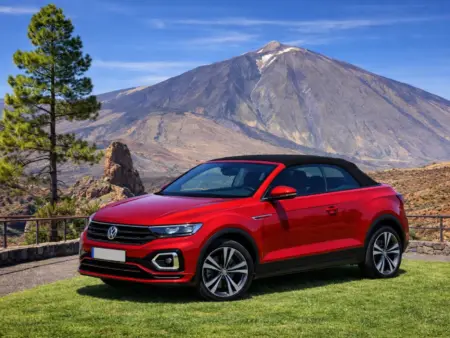
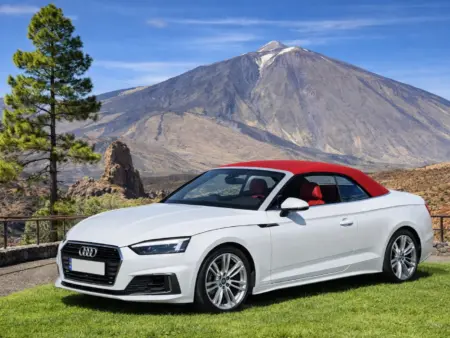
There is no universal winner between a hybrid and a battery-electric car for a Tenerife holiday. The useful question is whether the exact car, your overnight arrangements and the stops on your own itinerary make charging straightforward. Start with the trip you want to take, then check the vehicle and charging details; do not choose from a drivetrain label alone.
Start with the car, not the badge
“Hybrid” can describe different systems. Check the exact listing and vehicle documentation to see whether the car needs to be plugged in, what connector it uses and what the rental provider expects at return. A battery-electric vehicle must be recharged, but its usable range and charging times depend on the particular vehicle and conditions. This guide does not assume a specific range, charge level, cost or vehicle availability.
Mandry’s electric and hybrid car category is a place to inspect the current commercial options. Treat each listing as a starting point: confirm the exact vehicle, dates, terms and charging arrangements with the provider before deciding.
Match the choice to your plan
- Your situation: You expect to stay near one base; What to check before you choose: Ask whether charging is available where you will actually park overnight; a hotel name on a map does not confirm a charger or access.
- Your situation: You plan a day with several stops; What to check before you choose: Add the stops to a current route planner and identify a charging option that fits the day. Keep a second option in mind.
- Your situation: You do not want public charging to shape the itinerary; What to check before you choose: Check whether the exact hybrid is non-plug-in or plug-in. The label alone does not answer this.
MITECO’s official Ruta-e information describes a map and route calculator for finding reported charging points along a route. Use the live tool to inspect connector, power, access, payment and current status where shown. A map entry is a planning lead, not a promise that a charger will be free, compatible or operating when you arrive. [S1]
A short pre-booking checklist
- Get the exact model and drivetrain in writing.
- Confirm whether external charging is needed and which connector the car uses.
- Check the route in a current official charging map; inspect the individual stops, not just the total distance.
- Ask whether your accommodation has a usable charger and what access or payment rules apply.
- Confirm the provider’s return-charge requirements and any related terms.
- Save a backup charging option and recheck live status on the day.
A hybrid may suit a plan that should not depend on finding a compatible public charger, but verify the exact system. An electric car can suit a plan when the car’s documented capabilities and the charging stops you have checked fit together. Neither choice guarantees a better trip or lower cost.
Frequently asked questions
Will an electric car make my planned Tenerife loop?
Do not answer from the model name alone. Check the exact vehicle documentation, your route and elevation, starting and return charge requirements, and charging options along the way. Ask the rental provider to confirm any vehicle-specific point.
Is every hybrid charged from a plug?
No conclusion follows from the word “hybrid” alone. Verify whether the exact car is a non-plug-in hybrid or a plug-in hybrid and follow its own documentation.
Can I rely on a charging map?
Use it to plan and compare options, then check the selected point’s current details and status. Keep a backup; listings and live availability can change.
Illustration note: Any accompanying illustration is AI-generated and is not a documentary photograph of a specific rental vehicle or charging stop.
Sources and claim anchors (checked 2026-09-30)
- [S1] MITECO: mobile applications and Ruta-e — official description of Ruta-e’s map and route calculator for charging points; page checked 2026-09-30. The tool’s live records should be checked again when planning.