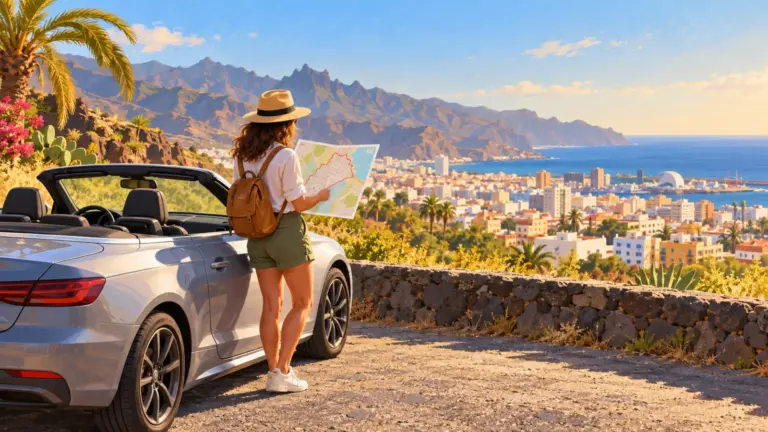
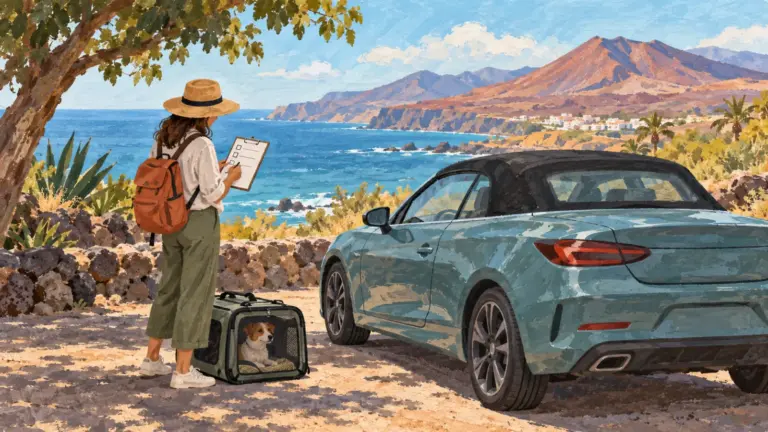
Tenerife rewards the open roof more generously than almost anywhere in Europe, and the coast is where it shows first. The island drops into the Atlantic in a series of moods – banana terraces and black rock in the north, sheer cliffs in the west, wide bright bays in the south – and a convertible turns the drive between them into the reason you came. What follows is how we drive the coast ourselves: the roads worth the detour, the stops worth the time, and the small practicalities that make the difference between a good afternoon and a memorable one.
Why the coast is best with the roof down
A coastal road gives you something a mountain pass cannot: constant, changing light. Along the shoreline the sun arrives twice – directly, and again reflected off the water – and with the roof down that light falls on you rather than through a window. The temperature shifts too. You feel the cool coming off the Atlantic as you round a headland, then the warmth radiating back from a lava wall on the inland side of the same corner. Sealed inside a car, none of this registers. Open, it becomes the texture of the drive.
Sound matters as much as light. The north coast has surf against volcanic rock, which is a heavier, deeper noise than sand-beach surf, and you hear it long before a viewpoint reveals the water. In the villages you catch fragments of ordinary life through the open cabin – a café terrace, church bells, someone calling across a square. These are the details that people remember about Tenerife, and they belong to the drive itself rather than to any single destination.
There is also a practical argument. Tenerife’s coastal roads are engineered for views, with frequent pull-outs and miradores placed exactly where the landscape opens up. An open car makes stopping worthwhile in a way a closed one does not, because you can take in a viewpoint without getting out at all. On a day with several short stops, that changes the rhythm of the whole route.
The TF-445 and the wild north-west
The north-west is the island at its least polished, and the road out to Punta de Teno is the clearest example. From Buenavista del Norte the TF-445 runs beneath enormous cliffs to a lighthouse at the island’s westernmost point, with the Los Gigantes cliffs standing across the water to the south. The setting is genuinely dramatic – and it comes with a condition attached. Because of rockfall risk, access for private vehicles is restricted, with a shuttle service operating in their place at certain times. The rules have changed more than once, so check the current arrangement before you set out, and treat the restriction as a serious one rather than a suggestion. When the road is open to you, few drives on the island match it.
Whatever the access situation, the approach itself is worth the morning. The TF-42 along the north coast is the old road, unhurried and continuously scenic, threading through Garachico and Icod de los Vinos. Garachico rewards a proper stop: the town was reshaped by the 1706 eruption, and the lava that destroyed its harbour now forms the natural rock pools at El Caletón. It is a strange and beautiful piece of history to stand in. Icod, a little further east, is known for the Drago Milenario, an ancient dragon tree that has become one of the island’s emblems.
Expect the north to be greener, cooler and more changeable than the south. The trade winds bring cloud against these slopes, which is precisely why the landscape is so lush – and why you should be relaxed about the roof. Cloud here often burns off by late morning or hangs above you without ever producing rain. Drive it as a morning route, allow more time than the distance suggests, and let the corners set the pace.
Southern sun runs and where to pause
The south is the reliable half of the island. Sunshine is more consistent, the light is harder and brighter, and the coastline opens into long bays rather than closing into cliffs. The TF-1 motorway makes distances short, which is useful for getting somewhere quickly, but the pleasure is in leaving it. The older TF-28 runs inland and above the coast through a string of villages, giving you the elevation and the corners that the motorway deliberately avoids.
Costa Adeje and Playa de las Américas are the obvious anchors in the south-west, and they work well as a base for evening drives along the seafront. Further west, the road towards Los Gigantes delivers the single most photographed view on this side of the island: vertical cliffs falling straight into deep blue water. Approach it in the late afternoon, when the rock face catches warm light rather than sitting in its own shadow.
On the south-east coast, El Médano offers a completely different character – flatter, windier, shaped by kitesurfers and the low cone of Montaña Roja. It is the least manicured of the southern resorts and the better for it, with a long beach and an easy, unhurried seafront. As a turnaround point on a coastal loop it is hard to improve on, particularly with a coffee stop before the drive back.
Practical tips: timing, wind and sun
Timing is the whole game with an open roof. Early morning and the last two hours before sunset are the best conditions of the day: the light is low and generous, the roads are quieter, and the sun is no longer directly overhead. Midday in high summer is the one period when many drivers prefer the roof up, simply because the sun is unrelenting. Plan the scenic sections around the edges of the day and use the middle for lunch, a beach, or a longer stop somewhere shaded.
Sun exposure is stronger here than most visitors expect, and it is easy to underestimate it with a breeze cooling you at 60 kilometres an hour. Sunscreen before you set off, reapplied during the day, is not optional – shoulders, forearms and the back of the neck take the most. Sunglasses are essential rather than stylistic. Wind buffeting is manageable on most coastal roads, but it increases noticeably above 80 and around exposed headlands; a wind deflector, where fitted, makes conversation possible again.
Two more habits worth adopting. Carry a light layer, because evenings cool quickly and any route that climbs inland will feel several degrees colder than the coast. And secure anything loose before you move – maps, hats, paper bags and phone cables all leave an open cabin faster than you would think. Beyond that, the logistics are meant to be simple: we deliver to the airport or your hotel so the car is ready when you are, the deposit is refundable, and there is a real person on WhatsApp if anything needs sorting out mid-trip. The rest of the day belongs to the road.