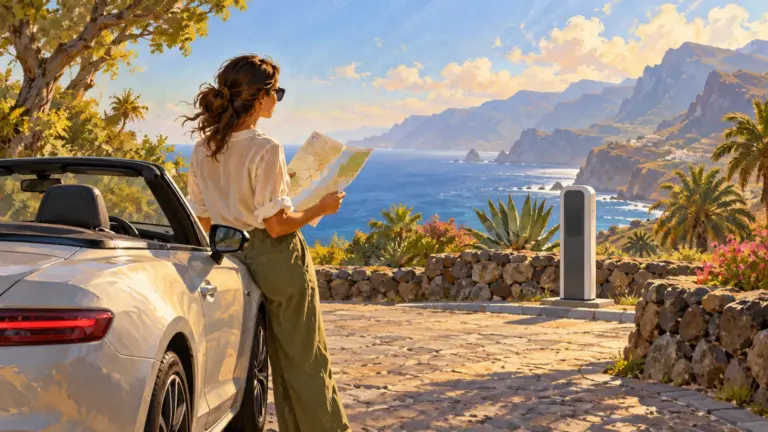
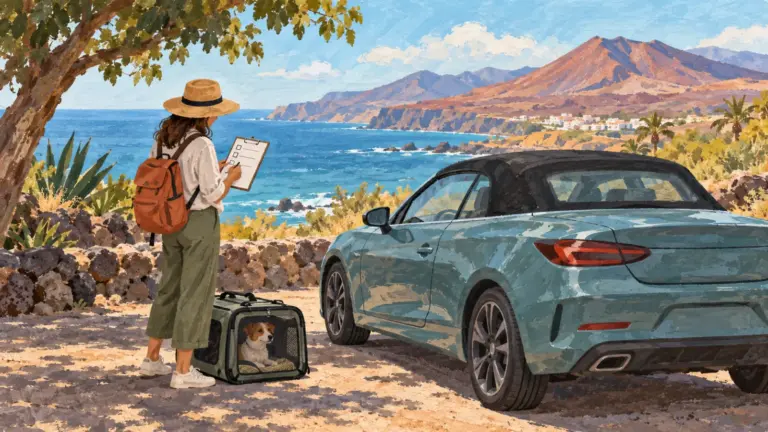
The north of Tenerife is the half of the island most visitors see least, and it is the half that rewards a slow day with the roof down. Colonial towns with wooden balconies, banana terraces running down to the sea, natural pools cut into old lava flows, and a coastline that stays green because the trade winds keep it that way. This is a full day, comfortably paced, that shows you the island most people miss.
Morning: La Orotava and the valley
Start in La Orotava, above Puerto de la Cruz, and start early. The historic quarter climbs a hillside in a grid of steep cobbled streets, with carved wooden balconies, small squares and courtyards that appear as you pass open doorways. The Casa de los Balcones is the best known building and worth the stop, but the pleasure here is simply walking a few streets before the day warms up.
Park at the edge of the old town rather than trying to drive into the middle of it. The streets are narrow, steep and frequently one-way, and the gradients are severe enough that a manual car will get your full attention. Half an hour on foot covers the best of it.
The drive down through the Orotava valley is the reason to do this section by car. The road descends through terraces and banana plantations with the whole valley opening below and, on a clear morning, Teide standing behind you in the mirror. It is a short distance and an entirely different landscape at each end.
Midday: Puerto de la Cruz
Puerto de la Cruz is the north’s principal town and it has aged well. It was one of the first resorts in the Canaries and it kept the character that came with that: a working harbour, a proper old quarter, plazas with real shade, and a seafront built for walking rather than for through traffic. It makes an easy midday stop.
Two places anchor a visit. Lago Martianez is a complex of seawater pools laid out by Cesar Manrique, all white curves and black volcanic rock, and it remains one of the most elegant pieces of design in the islands. Playa Jardin, at the western end of town, is a long black-sand beach backed by subtropical gardens, which is a good place to sit even if the Atlantic looks too energetic for swimming. For more of the island’s volcanic beaches, see Tenerife’s black-sand beaches by cabrio.
For lunch, head into the streets behind the harbour rather than eating on the front. The old town has small places serving local fish, papas arrugadas and mojo, generally at better prices and with better cooking than the seafront terraces. Park once, on the edge, and walk; the centre is compact and the one-way system is not worth arguing with.
Afternoon: coast and rock pools
The afternoon belongs to the coast road west. The TF-42 runs through Los Realejos, Icod de los Vinos and Garachico, and it is continuously scenic in a way the motorway below it is not. Icod is home to the Drago Milenario, the enormous dragon tree that has become an emblem of the island. It is visible from the road and from a small park beside it.
Garachico is the highlight. The town was buried by a lava flow in 1706, and the lava that destroyed its harbour now forms El Caleton, a set of natural pools where the sea washes in over black rock. Swimming there, in clear water inside a lava field, is one of the more memorable things you can do on the island. The old town behind it is quiet, handsome and largely free of resort development.
If you want somewhere less known, Charco del Viento near La Guancha is a natural pool reached down a rough lane through banana plantations, with dramatic rock and Atlantic swell close by. Conditions matter at all of these places: they are open to the ocean, and on days with any real swell they become dangerous rather than merely lively. Check before you get in, and stay out if the sea is working.
The drive home
You have two options, and they suit different moods. The TF-5 motorway runs along the north coast and gets you back quickly, which matters if you are staying in the south and the light is going. The old coast road is slower, prettier and better with the roof down, and it is the right choice if you still have an hour of daylight to spend.
If you are heading south, there is a third possibility worth considering: return over the mountain rather than around the coast, climbing on the TF-21 through the pine forest and crossing the high plateau at the end of the day. The evening light on the caldera is extraordinary. It adds time and a jacket becomes essential, but it turns the journey home into the best part of the day.
Whichever way you go, fill the tank before you leave the coast, allow more time than the distance suggests, and expect the north to be cooler and possibly damp by evening. The trade winds bring cloud back against these slopes in the late afternoon, which is precisely why everything you drove past today was green.