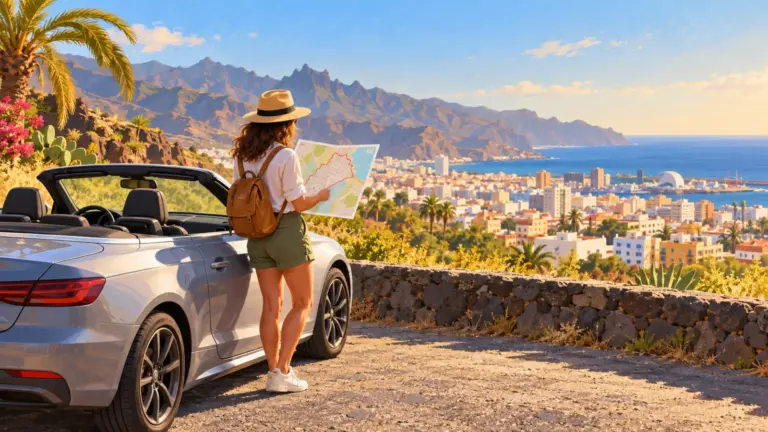
The last hour of daylight is when Tenerife is at its most generous. The heat goes out of the day, the light turns amber, the roads empty of tour traffic, and the west-facing coast lines up perfectly with the setting sun. A convertible is built for exactly this hour. These are the drives we recommend when someone asks what to do with an evening.
Where the sun sets best
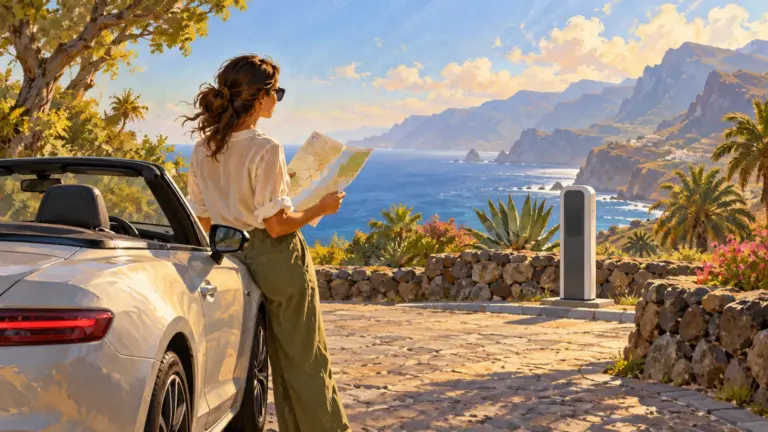
Geography decides it. The west and south-west coasts look straight out over open Atlantic, with the island of La Gomera sitting on the horizon as a dark silhouette. As the sun drops behind it the sky moves through orange into deep pink, and the water holds the colour long after the sun has gone. Anywhere between Costa Adeje and Los Gigantes gives you this, and the cliffs at Los Gigantes make the most theatrical version of it.
The north coast works differently. At Puerto de la Cruz the sun sets along the coastline rather than in front of it, which lights the cliffs and the sea stacks from the side and produces a warmer, softer effect. On days when the cloud layer sits offshore, the underside of it catches the last light and turns the whole northern sky copper.
There is one phenomenon worth planning for. Around sunset, Teide can cast an enormous triangular shadow that projects eastwards across the sea and the cloud layer. Seen from high ground, or from the mountain itself, it is one of the strangest sights on the island: a perfect dark pyramid stretching to the horizon, entirely unlike the shape of the mountain casting it.
Three easy golden-hour routes
The first is the cliff run. Start at Playa de la Arena or Puerto de Santiago about ninety minutes before sunset and drive north towards Los Gigantes, taking the viewpoints as you go. The cliffs face west, so they catch full warm light while the water below falls into shadow. Continue up towards Tamaimo if you want elevation, or stop at the marina and watch from there.
The second is the resort seafront. From Costa Adeje southwards there are long stretches of promenade road with the sea on your right the whole way. It is the least demanding drive of the three, ideal at the end of a full day, and it ends conveniently close to dinner. Traffic is heavier here, so leave a little earlier than you think.
The third is the high road. Rather than chasing the coast, climb inland on any of the roads above the south-west and stop where the land falls away. From a few hundred metres up you see the sun set into the ocean with the whole coastline laid out below and the sky filling most of the view. This is the option to choose when the coast is busy, and it is by far the best for photographs.
Dinner stops with a view
The small coastal towns are more rewarding than the resort strips for an evening meal. Alcala has a harbour, a square and several places to eat fish within sight of the water. Playa San Juan is similar in character and slightly larger. Both sit directly on the sunset coast, so you can time the drive to arrive as the light goes and eat afterwards rather than watching through a window.
In the north, Garachico and Puerto de la Cruz both offer terraces close to the sea, with the added advantage that the north coast stays lively later. Further round, Punta Brava and the smaller places above the cliffs are quieter and more local. Anywhere with a terrace facing water will do the job; the point is to stop rather than keep driving once the colour arrives.
Book ahead in high season, particularly at weekends, and particularly for a table with a view. These are small restaurants in small towns and the good tables go early. If you have not booked, arriving before the local dinner hour rather than during it improves your chances considerably.
Making the most of the light
Leave earlier than the sunset time suggests. The best light begins roughly an hour before the sun touches the horizon and the best colour often arrives ten to twenty minutes after it has gone. Arriving exactly at sunset means missing both halves. Give yourself time to find a stopping place too, since the obvious viewpoints fill up.
Take a layer. Once the sun is down the temperature falls quickly, especially with the roof open and the sea breeze picking up, and the drive home is usually the coolest part of the evening. A jacket in the boot turns a chilly return into a pleasant one, and means you can keep the roof down rather than closing it after ten minutes.
Finally, plan for the dark. Mountain roads are considerably more demanding at night, with no lighting and frequent blind corners, so if your viewpoint was inland, allow proper time for the descent and take it gently. Clean the windscreen before you set off, since low sun on a dusty screen is genuinely blinding. And keep the phone in a pocket rather than on the seat, because the one thing guaranteed to end a golden-hour drive early is watching it disappear over the door.